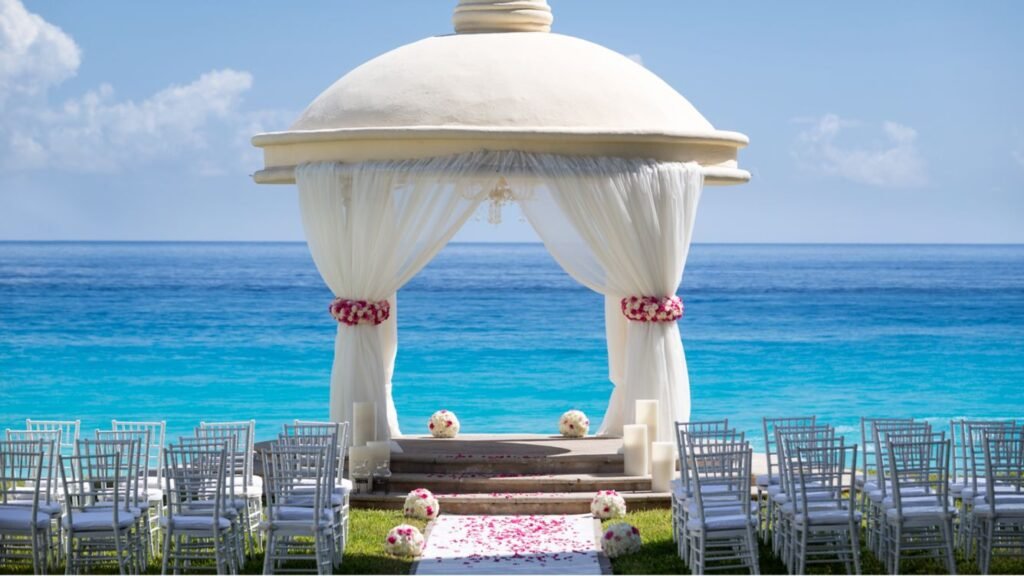

Choosing an adults-only destination wedding resort is not a style decision. It is a guest-list decision, and it is functionally the same as mailing an invitation that says some of your family cannot come. Adults-only properties are typically 18-plus with no exceptions – not for a nursing infant, not for a well-behaved nine-year-old, not for your goddaughter. Family-friendly resorts include everyone but change the texture of the week. Before you fall in love with a photograph, work out who is actually on your list. Here is the framework I use with couples, including the conversations nobody warns you about.
What does “adults-only” actually mean at a resort?
It means a minimum age for staying on the property, almost always 18, enforced at check-in. It is not a quiet-hours policy or a suggestion. A child cannot stay in your room, cannot eat in the restaurants, and in most cases cannot be brought onto the property as a day guest for the ceremony.
That last point catches people out. Couples routinely assume they can book a sister at a nearby family resort and have her bring the baby over for the vows. Usually she cannot.
The trade you are buying is real. Excellence Playa Mujeres in Cancun is adults-only, with ten restaurants, the Miilé Spa, and wedding venues sized for intimacy rather than volume – a Beach setting for around seventy, a Stone Gazebo and Spice Terrace at around forty-five, and a Convention Center Ballroom at around seventy. That is a property built for a certain kind of week: no splash pad noise at the pool, no children’s buffet, a hushed dinner service. If your wedding is forty adults and you want it to feel like a long, elegant weekend, it is close to perfect.
Who are you actually excluding?
Do this before anything else. Open your guest list and mark every household with someone under 18. Not “kids we would invite” – every household where a child exists, because a parent who cannot bring a child often cannot come at all.
Then be honest about which of those households have alternatives. A couple with a twelve-year-old and grandparents in the same city can leave the child at home for four nights. A single parent cannot. A family with a six-month-old cannot. A family with three children under ten will not pay for childcare plus two international flights.
In my experience, when more than about a quarter of a guest list has young children, adults-only starts costing real attendance – and, more painfully, it costs the specific people whose absence you will feel in the photographs. That is a decision you are allowed to make. But make it with the names in front of you, not as an abstraction.
There is a version of this that goes badly, and I have watched it: the couple picks adults-only for the aesthetic, tells themselves everyone will understand, and finds out at month seven that the bride’s brother – a father of two who cannot afford a nanny for a week – has quietly stopped replying to texts. That wound outlasts the wedding.
How do you tell family with young children they cannot come?
You do it early, directly, by phone, and before the save-the-dates. Not in a line at the bottom of a wedding website.
What works is naming the constraint rather than framing it as a preference. “We’ve chosen an adults-only resort, which means the property doesn’t allow anyone under 18 to stay – I wanted you to hear that from me rather than read it.” That is true, it is not a judgment of their child, and it gives them room to problem-solve rather than feel rejected.
What does not work is “no kids” as a rule you are imposing. It invites negotiation, and once you make an exception for one child you have made it for all of them.
Give people something. Offer to help find childcare. Offer to loop them into a livestream of the ceremony. Offer, genuinely, to host something at home when you are back. And accept the answers you get: some people will not come, and that is the cost of the choice, not a failure of the conversation.
One more honest thing. If there is a specific person whose presence matters more to you than the resort’s atmosphere – your only sibling, the grandmother who raised you, your best friend who is a single parent – then the guest list has already answered the question. Choose the family-friendly property.
What are the split-resort and hybrid strategies?
There are two workable ways to have both, and they are frequently confused.
The split-resort approach puts your adults-only guests at one property and families at a neighboring one, with events at whichever resort hosts the wedding. It is genuinely appealing on paper. In practice it introduces a second contract, a second room block, transport between properties for every event, and a real risk that your group never feels like one group. It works best when the two properties are walking distance or a five-minute shuttle apart and when your planner controls both blocks. It works poorly across a thirty-minute drive.
The hybrid resort is usually the better answer, and it is the option most couples do not know exists. These are single complexes containing both an adults-only wing and a family wing, sharing grounds and often sharing dining.
Hard Rock Riviera Maya is the clearest example. The property splits into Hacienda, the family side with the kids’ club and water park, and Heaven, the adults-only 18-plus side with its own restaurants, bars, pools and a private adult beach. Guests are wristbanded at check-in, Heaven guests may use the Hacienda facilities freely, and Hacienda guests can dine at Heaven’s restaurants when space allows, with priority going to Heaven guests. Your child-free friends get the quiet pool; your cousin’s kids get the water slide; everyone attends the same ceremony. The wedding inventory is enormous – a Convention Center rated to around 1,500, a Woodstock Terrace around 300, Stairway to Haven around 200 – alongside 13 pools, nine restaurants, a Jack Nicklaus-designed course and a casino.
Grand Palladium Costa Mujeres, about 35 km north of Cancun airport, works the same way. The Grand Palladium side is family-friendly with a kids’ club; TRS Coral within the same complex is adults-only 18-plus with butler service, and TRS guests retain access to the wider Palladium dining. Venue capacities here are the largest we work with regularly – a beach setting rated to around 500 and a convention center to around 700, plus a Crystal Chapel around 100 and a range of terraces from 80 to 150. Dining spans Chang Thai, Portofino, El Dorado, Sumptuori, Bhogali and La Adelita.
The Barceló Maya Grand Resort complex on the Riviera Maya follows the same pattern, with Barceló Maya Beach among the family properties and a separate adults-only Barceló Maya Riviera.
How do the three options compare?
| Adults-only | Family-friendly | Hybrid (adults-only wing) | |
|---|---|---|---|
| Guests under 18 | Not permitted, typically 18+ minimum | Welcome | Welcome, in the family section |
| Likely attendance impact | Loses households with young children | Highest attendance | Highest attendance |
| Atmosphere | Quiet, adult, consistent | Lively; varies by pool and hour | Both, by wing |
| Typical wedding scale | Intimate, roughly 30 to 75 | Small to very large | Small to very large |
| Group cohesion | Strong | Strong | Good; requires deliberate planning |
| Awkward conversations | Several, unavoidable | None | Essentially none |
| WP360 examples | Excellence Playa Mujeres | Hyatt Ziva Cancun | Hard Rock Riviera Maya, Grand Palladium Costa Mujeres |
How does each option change the guest experience?
At an adults-only property, the whole week reads as one register. Dinner is quiet. The pool is quiet. Your friends without children exhale in a way they may not have in years. The flip side is that the energy can be flat if your group skews older or if the wedding party is small – there is no natural chaos to carry a slow afternoon.
At a family resort, the wedding becomes a family holiday with a wedding in it. Hyatt Ziva Cancun, in Punta Cancun, is a good illustration of what that buys you: a kids’ club, three oceanfront infinity pools, 17 restaurants and bars, and a venue range that stretches from a 65-guest Cliff Gazebo to a Sahara Beach setting rated to around 400 and an Elements Ballroom to around 745. Your guests with children get a week they can actually afford to take, and the parents get a few hours off. The honest cost is ambient noise, busier restaurants and a less curated feel.
A practical middle path at a family resort: book a private venue for the reception and set an adults-only reception policy while children are welcome at the ceremony and welcome dinner. Parents get a real evening; children are included in the meaningful moment; nobody has to be excluded from the trip. This is what I steer most mixed guest lists toward.
So which should you choose?
Choose adults-only if fewer than roughly a quarter of your households have young children, if your list skews toward friends rather than extended family, and if a consistently quiet, elegant week is the point of the trip.
Choose family-friendly if children are meaningfully represented on your list, if you have single parents or infants among people you cannot imagine missing it, or if the wedding is a rare full-family gathering.
Choose hybrid if you want the adults-only atmosphere for the guests who want it without excluding anyone. For most couples with a genuinely mixed list, this is the correct answer and it is the one that gets overlooked.
If you are stuck between two properties, send us your guest list shape – households, ages, rough budget – and we will model attendance against each option. Book a free planning appointment and we will do that with you before you sign anything.
Frequently asked questions
Can children attend just the ceremony at an adults-only resort?
Usually not. Most adults-only properties enforce the age minimum for anyone on the grounds, including day guests. Never assume this is negotiable – get the day-pass policy in writing from the resort before you build a plan around it.
Is the minimum age always 18?
Eighteen is the most common threshold, and it is the policy at properties such as Excellence Playa Mujeres, TRS Coral and the Heaven section at Hard Rock Riviera Maya. Some resorts elsewhere use 16 or 21. Verify the specific property rather than assuming a brand-wide rule.
What if a guest is 17 and in the wedding party?
At a strictly 18-plus property, they cannot stay, and this is not usually waivable. If a teenager is in your wedding party, that alone should push you toward a family-friendly or hybrid resort. It is a much smaller compromise than removing a sibling from the aisle.
Do adults-only resorts cost more?
Not inherently. They tend to sit in a more upscale tier and price accordingly, but a premium family resort can easily cost more per night than a mid-tier adults-only one. The bigger budget effect is on your guests: families booking two rooms feel destination pricing very differently than couples booking one.
Can we do adults-only for the reception but not the whole trip?
Yes, and at a family resort this is often the best of both. Children attend the ceremony and welcome event; the reception is adults-only in a private venue. Arrange childcare through the resort’s kids’ club and communicate the plan clearly in your invitation wording so no parent is surprised on the day.
How do we handle a guest who pushes back hard?
Answer once, warmly, with the constraint rather than the preference – the property does not permit under-18 guests. Do not relitigate it, and do not make a single exception, because one exception makes the policy indefensible for everyone else. Then offer what you can: help with childcare, a livestream, a celebration at home.