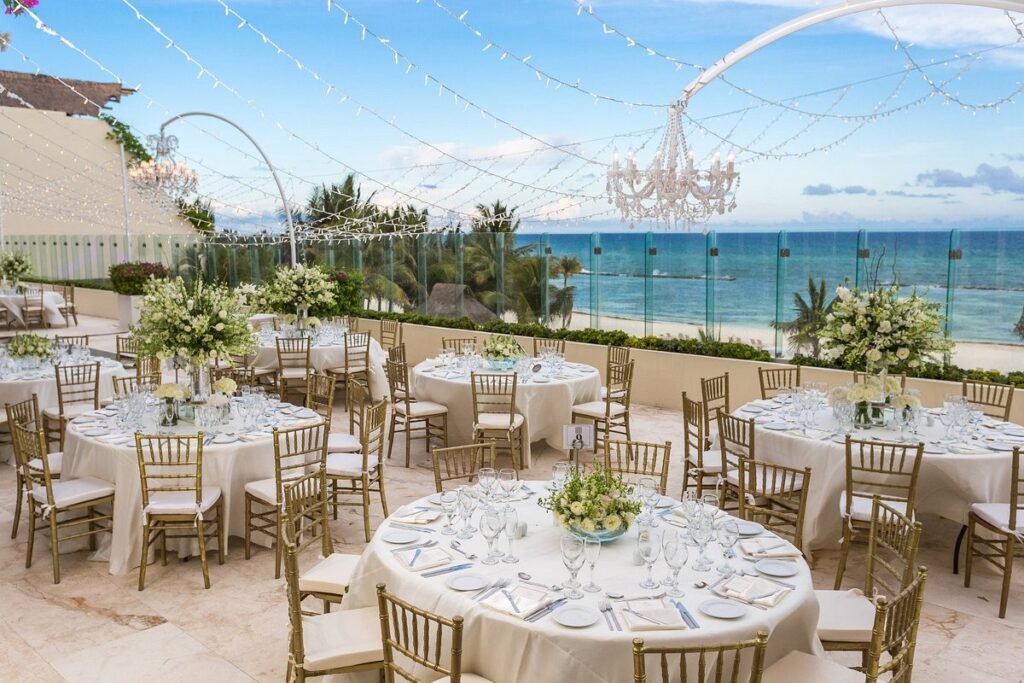
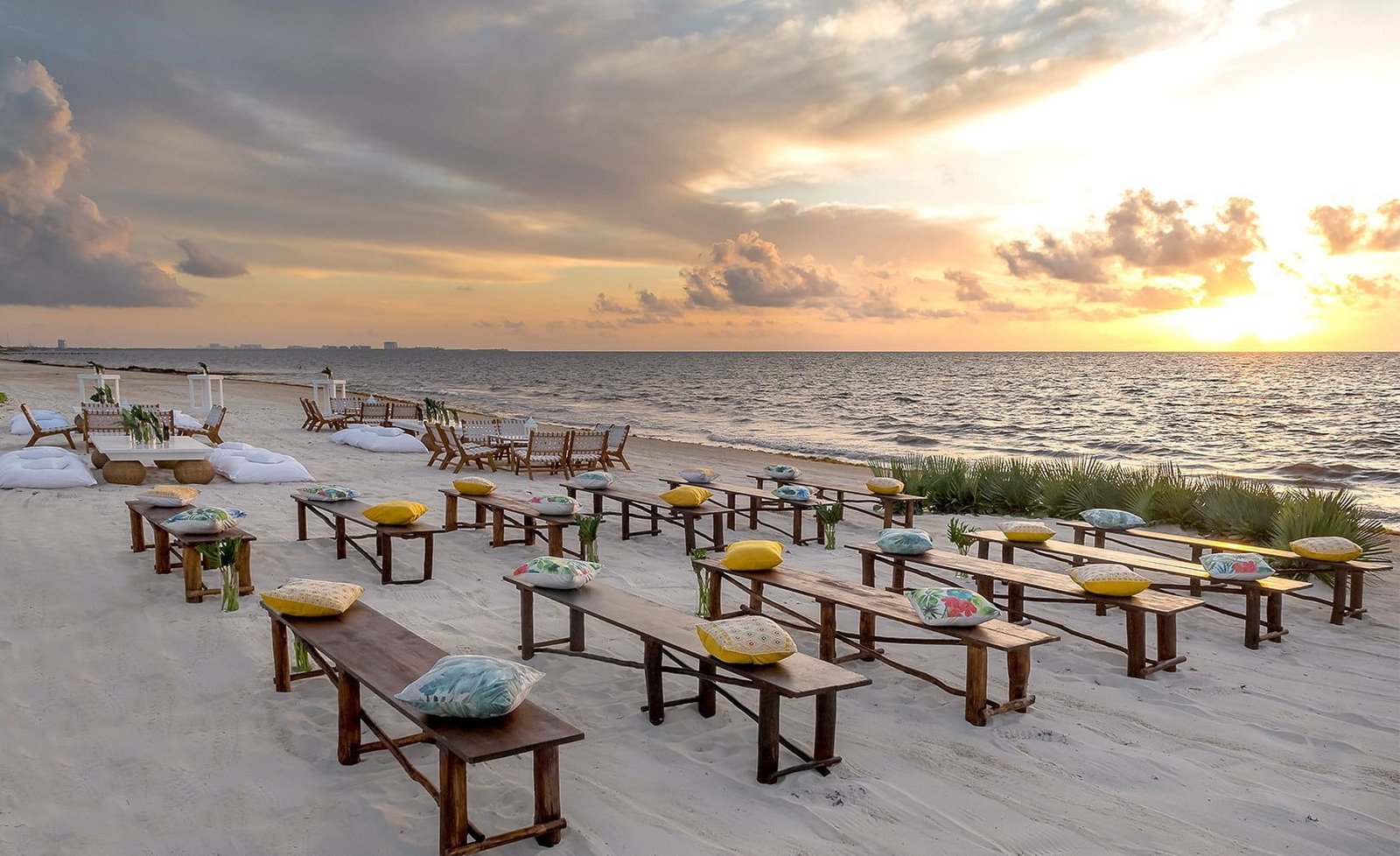
The short answer: the best months for a destination wedding on Mexico’s Caribbean coast are late November through April, with January, February and March being the safest of all. That window sits entirely outside Atlantic hurricane season, delivers the driest weather of the year, and avoids the worst of the summer heat. The trade-off is money: those same months are peak season and priced accordingly. If your budget matters more than your odds of perfect weather, May and early December are the two windows I steer couples toward most often.
What are the real seasons in Mexico’s Caribbean?
Forget the four seasons you grew up with. The Yucatán has two, and your wedding day lives or dies by which one you’re in.
The dry season runs roughly November through April. Cooler nights, far less rain, lower humidity, and clearer water. The rainy season runs May through October, and it is genuinely muggy, with the heaviest rainfall of the year concentrated in September and October.
Layered on top of that is the one thing couples ask about most: Atlantic hurricane season officially runs June 1 to November 30, according to NOAA’s National Hurricane Center. The statistical peak of the season is September 10, with most activity falling between mid-August and mid-October. Storms occasionally form outside those dates, but that six-month bracket is the number to plan around.
If you are considering Mexico’s Pacific side instead – Los Cabos, Puerto Vallarta – note the Eastern Pacific hurricane season starts earlier, on May 15, and also ends November 30, with peak activity from July through September. The pattern is different but the caution is the same.
What does each month actually look like?
Below are Cancun’s long-term climate averages alongside the practical planning notes I give couples. Temperature and rainfall figures are 1981 to 2010 normals; treat them as the shape of the year, not a forecast for your date.
| Month | Avg high / low (°F) | Rain (in) | Rainy days | Hurricane risk | Pricing | Planner’s verdict |
|---|---|---|---|---|---|---|
| January | 83 / 68 | 4.1 | 10 | None | High | Excellent. Cooler evenings; occasional cold fronts bring brief rain. |
| February | 85 / 69 | 2.0 | 6 | None | High | One of the two best months of the year. |
| March | 87 / 70 | 1.8 | 5 | None | High | Superb weather. Spring break crowds are the only downside. |
| April | 90 / 73 | 1.1 | 4 | None | High | Driest month of the year. Watch Semana Santa pricing. |
| May | 92 / 75 | 3.5 | 7 | None (Atlantic) | Shoulder | Best value-to-risk month. Hot, but pre-hurricane season. |
| June | 93 / 76 | 5.6 | 11 | Low, season opens | Shoulder | Hot and humid. Peak seaweed. Proceed with insurance. |
| July | 94 / 77 | 2.7 | 9 | Low to moderate | Mid (summer bump) | Hottest month. Family-holiday demand lifts rates. |
| August | 95 / 76 | 3.4 | 9 | Rising sharply | Mid | Peak heat plus rising storm odds. I discourage it. |
| September | 93 / 76 | 7.2 | 14 | Highest | Lowest | Statistical peak of hurricane season. Cheapest for a reason. |
| October | 89 / 74 | 11.1 | 17 | High | Lowest | Wettest month by a wide margin. Avoid. |
| November | 86 / 72 | 5.0 | 11 | Falling; season ends Nov 30 | Shoulder | Late November is a genuine sweet spot. |
| December | 84 / 69 | 3.5 | 10 | None | Early: shoulder. Late: peak | First two weeks are the best value in the dry season. |
How bad is hurricane season really?
Here is the honest, unglamorous truth: the probability that a hurricane hits your specific resort on your specific date is low, even in September. Thousands of weddings take place on this coast during hurricane season and the overwhelming majority go ahead exactly as planned.
But that is the wrong way to think about the risk. The question is not “will a storm hit us.” The question is “what happens if a named storm is anywhere in the western Caribbean during our wedding week.” Because the answer is: airlines cancel and rebook, guests panic, some don’t travel, resorts activate storm protocols, outdoor venues get struck, and you spend the week before your wedding refreshing a forecast map instead of enjoying your welcome dinner.
The disruption radius of a hurricane is enormous compared with its damage radius. That is why I counsel couples away from mid-August through October – not because I expect catastrophe, but because I have watched perfectly fine weather weeks ruined by the anxiety of a storm that ultimately went to Florida.
If you do book inside hurricane season, three non-negotiables: buy comprehensive travel insurance with a named-storm provision, choose a resort with strong indoor venue alternatives, and get the resort’s cancellation and postponement policy in writing before you pay anything.
When is it cheapest to get married in Mexico?
September and October are the cheapest months by a considerable margin, with resort rates reported to fall dramatically against peak season. They are also the wettest months and the height of storm risk. That is not a coincidence; it’s a market pricing risk accurately.
The genuinely useful discounts are in the shoulder windows:
- May – hot and humid, but before Atlantic hurricane season opens and well below high-season pricing. The best risk-adjusted value of the year.
- Late April, after Semana Santa – prices soften noticeably once Easter and spring break traffic clears, while the weather is still superb.
- November, particularly the second half – hurricane season is winding down, the dry season is arriving, and rates haven’t hit December peaks yet.
- The first two weeks of December – in my view the single best combination of weather and price all year, right before holiday rates take hold.
Which weeks should you avoid on price alone?
Certain weeks carry premiums that have nothing to do with weather and everything to do with demand. Resorts commonly impose minimum-stay requirements and blackout dates for group blocks across:
- Christmas through New Year – the most expensive week of the year, frequently with minimum-night requirements that inflate your guests’ costs well beyond your wedding weekend.
- Semana Santa / Easter week – Mexico’s own major domestic holiday. Resorts fill with local families and rates climb.
- US spring break, roughly early-to-mid March – great weather, but Cancun’s Hotel Zone in particular takes on a very specific character. If your guest list skews older, consider late March instead.
- US Thanksgiving week – a demand spike that catches couples off guard when they’re otherwise targeting the excellent late-November window.
None of these are disqualifying. But if you are choosing between two dates and one falls in a premium week, that difference will show up in every guest’s booking, not just your own budget.
What about seaweed?
Sargassum is the factor couples don’t think to ask about until they see photographs. It is a floating seaweed that washes onto Caribbean beaches seasonally, and it can turn a postcard shoreline into something you would not want in your ceremony backdrop.
The season broadly runs April through October, peaking around June to August, and volumes vary substantially year to year. November through March are the most reliably clear months. This significantly strengthens the case for a dry-season wedding, and it is a real argument against June and July even though those months score reasonably on rainfall.
If your date does fall in seaweed season, ask your resort directly what their daily beach cleaning protocol is and whether they use offshore barriers. Some properties invest heavily in this; others do not. It is a fair question and a revealing one.
How hot is too hot for an outdoor ceremony?
Look at the table again: highs sit in the 90s from April through September, with July and August peaking at 94 to 95°F. Add Caribbean humidity and a suit, and a 3pm outdoor ceremony in August becomes genuinely uncomfortable for elderly guests.
Two practical fixes that work regardless of month. Time the ceremony late – 4:30pm or later, which also gives you the light photographers want. And provide shade, water and fans as standard, not as an afterthought. In the December-to-March window this matters far less, which is one more quiet argument for the dry season.
Frequently asked questions
What is the single best month for a wedding in Mexico?
If weather is your only criterion, February or March. Both sit in the heart of the dry season, well outside hurricane season, with comfortable temperatures and very few rainy days. March averages under two inches of rain across roughly five wet days.
Can we get married in Mexico in July or August?
You can, and many couples do because it’s when they can get time off. Go in with clear eyes: these are the hottest months, they fall inside hurricane season with risk climbing sharply through August, and they are peak seaweed months. If you must, choose a resort with strong covered venue options, schedule the ceremony late in the day, and buy proper insurance.
How far ahead should we lock a date?
For a peak-season Saturday with a substantial guest list, 12 to 18 months. The binding constraint is usually the room block rather than the venue. If you’re targeting a shoulder month such as May or late November, you have meaningfully more flexibility.
Does travel insurance actually cover hurricanes?
Only if you buy it before a storm is named, and only if the policy includes a named-storm or weather provision. Standard policies frequently exclude “known events,” so once a system is named it is too late. Buy early and read the weather clause specifically. For any date between June and November, treat this as mandatory rather than optional.
Is the Pacific coast a safer bet than the Caribbean?
Not automatically. The Eastern Pacific hurricane season starts two weeks earlier, on May 15, and runs to November 30 with peak activity July through September. The rainfall and humidity patterns differ from the Yucatán, but summer is still summer. Choose your coast on the wedding you want, then choose the month.
What happens if a hurricane is forecast during our wedding week?
With a good planner and a well-chosen resort, you postpone or relocate the ceremony indoors rather than cancel. This is exactly why venue depth matters when you’re picking a property, and why we push couples toward resorts with credible covered alternatives when their dates fall inside the season.
So what should you actually do?
If you can marry between late November and April, do. You are buying the best weather of the year and paying a premium for it, and in my experience couples rarely regret that trade. If the budget won’t stretch, take May or the first half of December and accept a little heat or a little compromise instead of taking on storm risk. And if September or October is your only option, be honest with yourself about what you are accepting, then insure it properly.
Dates drive everything else – pricing, availability, which resorts will even hold a block for you. It is the first decision, not the last.
Book a free consultation with WeddingPlan360 and we’ll pressure-test your shortlist of dates against real availability and pricing before you commit to anything.
Resorts worth looking at once you’ve picked a month
Date and venue decisions are tangled together, so it helps to look at both at once. For dry-season weddings with large guest lists, Grand Palladium Costa Mujeres offers fourteen listed venues including indoor ballrooms and a convention centre – useful depth if your date carries any weather risk. Hyatt Ziva Cancun pairs beach ceremony spaces with the indoor Elements Ballroom and a covered Sky Terrace. For adults-only celebrations under 70 guests, Excellence Playa Mujeres lists both beach and Convention Center Ballroom options, so a wet forecast doesn’t end the day. And for smaller, high-end weddings, Waldorf Astoria Cancun has an indoor ballroom seating 180 alongside its pavilion and terrace.
Whatever month you land on, the rule holds: never book an outdoor-only ceremony space in Mexico without knowing exactly where you go if it rains.